Organizing tips · Aug 25, 2026 · 6 min read · By Blue Dots Team
Why You Can't Remember Where You Put Things | Blue Dots
Your brain files objects by place, not by name. The Nobel Prize-winning science of spatial memory, and why a photo of your room beats any list.
Your home is already a memory palace
You're in the garage, holding the wrong box. The soldering iron is in one of these. You can picture the shelf it used to sit on, roughly the height, even the colour of the lid. What you can't do is match that picture to a label that says HOBBY 3.
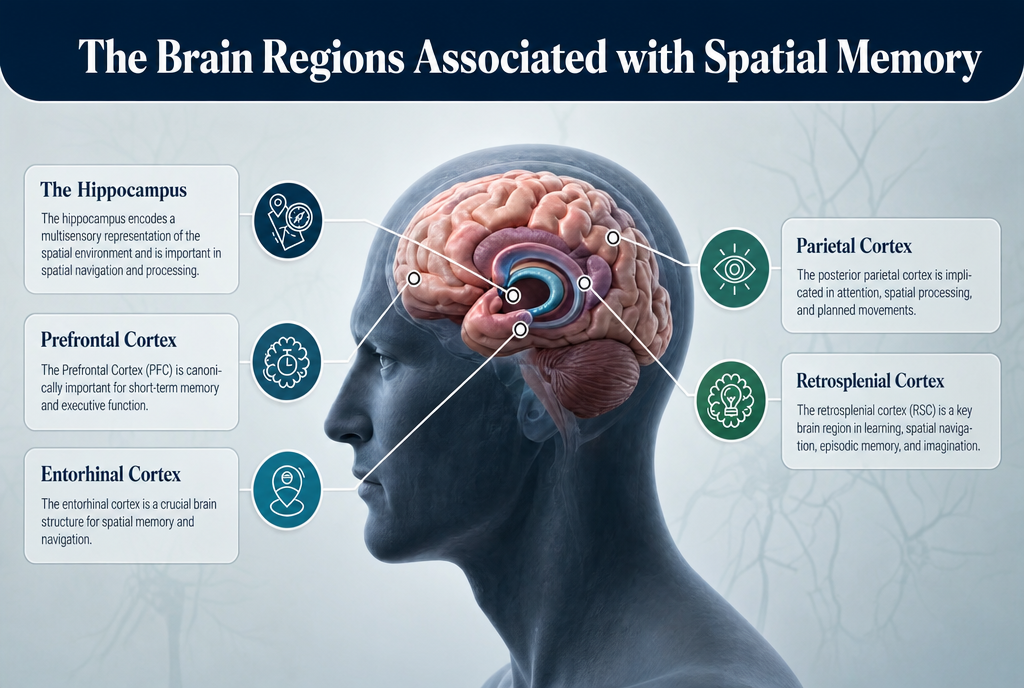
That gap has a well-mapped explanation. Your brain stores the location of objects in a spatial system built on dedicated cells in the hippocampus and entorhinal cortex, work that won the 2014 Nobel Prize in Physiology or Medicine. That system thinks in places and scenes. Lists, labels and spreadsheets think in words. If you ever wondered why you can't remember where you put things even though you "wrote it down", this is usually why: the record is in a format your brain never uses for finding anything.
The research below spans 2,500 years, one collapsed banquet hall, ten memory champions and 10,000 photographs. It ends somewhere practical, because the building you know best is already the best memory aid you own.
A collapsed roof, 500 BC
The memory palace has a founding story. The Greek poet Simonides of Ceos stepped out of a banquet moments before the roof came down. The bodies were crushed beyond recognition and the families could not identify their dead. Simonides could. He closed his eyes, walked the table in his mind, and named each guest by where they had been sitting. The story reaches us through Cicero and is probably polished legend. The technique it launched is not.
Greek and Roman orators turned it into a method: take a building you know well, place the things you need to remember at points along a route through it, then walk the route to retrieve them. The Rhetorica ad Herennium, written around 80 BC, already treats this as standard professional practice. Memory athletes use the same method today, now called the method of loci, to memorise shuffled card decks and thousand-digit numbers.
Your brain runs on a positioning system
In 1971, John O'Keefe recorded from single neurons in the rat hippocampus and found cells that fired only when the animal stood in one particular spot. He called them place cells. In 2005, May-Britt and Edvard Moser, working in Trondheim, found grid cells one synapse upstream in the entorhinal cortex: neurons that tile the environment in a hexagonal coordinate grid. The three shared the 2014 Nobel Prize for what the committee described as an inner positioning system in the brain.
Location is not one more attribute your memory attaches to an object, like colour or weight. It sits closer to the filing system itself. The hippocampus, the structure at the centre of forming new memories, is the same structure that maps space, and a long line of research treats those two jobs as one job.
London taxi drivers gave the famous demonstration. To earn a licence they memorise roughly 25,000 streets, and Eleanor Maguire's brain scans in 2000 showed their posterior hippocampi were enlarged compared with controls, more so the longer they had been driving. Detailed real-world space is heavy lifting for this system, and the system visibly adapts to carry it.
There is even dedicated cortex for the views themselves. In 1998, Epstein and Kanwisher identified a region of parahippocampal cortex that responds selectively to scenes and places, rooms, houses, landscapes, while responding weakly to single objects or faces. Your brain treats the sight of a room as its own category of information.
Pictures are absurdly durable
In 1973, Lionel Standing showed volunteers 10,000 photographs, five seconds each, across five days. He then showed them pairs, one seen and one new, and asked which they recognised. They were right roughly four times out of five, and Standing estimated they had retained around 6,600 of the images. Nobody in that study was trying to memorise anything.
Psychologists call the broader effect picture superiority: images outlast words in memory, plausibly because they get encoded twice, once as a visual trace and once as a verbal one. That is Allan Paivio's dual-coding account. A word on a label gets one shot at your memory. A photograph of your shelf gets two.
Context does similar work at retrieval. In a 1975 experiment by Godden and Baddeley, divers who learned word lists underwater recalled them best underwater, and lists learned on land came back best on land. When the scene at recall matches the scene at encoding, the memory surfaces more easily. A photo of the actual room is that principle in your pocket: the encoding context, carried with you.
The champions have ordinary brains
Eleanor Maguire again, 2003. Her team scanned ten of the world's best memorisers, most of them ranked World Memory Championship competitors, expecting unusual anatomy or unusual IQ. They found neither. What separated the champions was strategy: nine of the ten used the method of loci, and during memorisation their brains engaged regions tied to spatial navigation, including the right posterior hippocampus. The advantage was spatial, and it was learned.
Martin Dresler's group closed the loop in 2017 in the journal Neuron. Ordinary adults trained on the method of loci for about 30 minutes a day over six weeks. Their recall on a 72-word test more than doubled, the gains were still present four months later, and their brains' functional connectivity had shifted toward the patterns seen in memory athletes. As memory techniques go, this one is unusually well evidenced.
It also has a famous adoption problem. The classic method asks you to invent a building, furnish it, populate it with deliberately bizarre imagery, and maintain the whole structure through practice. It works, and almost nobody sticks with it.
The palace you never had to build
You already own a memory palace: richly encoded, maintained daily, no imagination required. You can walk your own home in the dark. You know which stair creaks and which cupboard door sticks. Years of ordinary navigation have given your place and grid cells a dense, stable map of it, the real version of the structure the method of loci asks you to fake.
The mismatch happens at storage. When you catalogue your possessions as rows of text, in a spreadsheet, a notes app, a label maker, you translate spatial knowledge into the one format the positioning system can't index. Retrieval then runs on verbal memory, the system that loses your third errand by lunchtime.
Blue Dots™ was built on the opposite bet. You photograph your actual room, then pin blue dots on the photo where things actually live: this shelf, that drawer, the third box from the left. Each dot holds what's inside. Finding something means looking at a picture of your real shelf and tapping the spot your memory was already pointing at. One photo. A few taps. Everything findable.
A claim we are not making: no clinical trial has tested whether a cataloguing app improves anyone's memory, and until one exists you should distrust any app that says otherwise. The US Federal Trade Commission fined Lumosity 2 million dollars in 2016 over brain-training claims its evidence couldn't carry. The claim here is narrower and it stands on the research above: dots on photographs of your real rooms keep the record in the format your spatial system already speaks, so finding things rides place cells and picture memory instead of fighting them. The app borrows a strong system you already have.
Three ways to use this today
No app required for any of these.
Say the place out loud when you store something. "The passport is in the grey box, top of the wardrobe." You encode the location twice, verbally and spatially, which is the same doubling that makes pictures so durable. Photograph boxes before you seal them, and shelves before you rearrange them. Sealed cardboard defeats spatial memory because every box presents the same face. One photo per box restores the scene your brain actually filed. Give each thing one home. A fixed spot lets your spatial map do its job. "Safe places" fail for the same reason: a novel hiding spot has no worn path in the map, so when you finally need the memory, there is no route to walk.
If you want the photo-and-dots version handled for whole rooms, Blue Dots™ does exactly that. It is free to start, on iOS and Android. [INTERNAL LINK: / "Blue Dots"]
FAQ Why do I forget things I put in a "safe place"?
A safe place is usually a novel, low-traffic spot chosen precisely because nobody would look there, including future you. Novel locations have weak entries in your spatial map and few retrieval cues leading to them. Saying the location aloud, or photographing it, gives the memory a second route back.
Is the memory palace technique scientifically supported?
Yes, unusually well. Brain-imaging work by Maguire (2003) showed top memorisers rely on spatial strategy rather than special anatomy, and a randomised training study by Dresler (2017, Neuron) showed six weeks of method-of-loci practice more than doubled recall in ordinary adults, with gains lasting months.
What part of the brain remembers where things are?
Mainly the hippocampus, whose place cells fire at specific locations, together with grid cells in the entorhinal cortex that provide the coordinate system. A nearby region, the parahippocampal place area, specialises in recognising scenes such as rooms and buildings. This circuitry earned the 2014 Nobel Prize in Physiology or Medicine.
Do photos really help you find things?
Recognition memory for photographs is very strong: Standing's 1973 study estimated people retained thousands of images after brief single viewings. A photo of the real location also reinstates the context in which you stored the item, which is a well-documented retrieval aid. That combination is why a picture of your shelf outperforms a written list of its contents.
References O'Keefe, J. & Dostrovsky, J. (1971). The hippocampus as a spatial map. Brain Research. [EXTERNAL LINK: original place-cell paper] Hafting, T., Fyhn, M., Molden, S., Moser, M-B. & Moser, E. (2005). Microstructure of a spatial map in the entorhinal cortex. Nature. [EXTERNAL LINK: grid-cell paper] Nobel Assembly at Karolinska Institutet (2014). Press release: The Nobel Prize in Physiology or Medicine 2014. [EXTERNAL LINK: nobelprize.org press release] Maguire, E. et al. (2000). Navigation-related structural change in the hippocampi of taxi drivers. PNAS. [EXTERNAL LINK: taxi-driver study] Maguire, E., Valentine, E., Wilding, J. & Kapur, N. (2003). Routes to remembering: the brains behind superior memory. Nature Neuroscience. [EXTERNAL LINK: memory-champion study] Dresler, M. et al. (2017). Mnemonic training reshapes brain networks to support superior memory. Neuron. [EXTERNAL LINK: loci training study] Standing, L. (1973). Learning 10,000 pictures. Quarterly Journal of Experimental Psychology. [EXTERNAL LINK: picture-memory study] Epstein, R. & Kanwisher, N. (1998). A cortical representation of the local visual environment. Nature. [EXTERNAL LINK: parahippocampal place area paper] Godden, D. & Baddeley, A. (1975). Context-dependent memory in two natural environments. British Journal of Psychology. [EXTERNAL LINK: diver study] Federal Trade Commission (2016). Lumosity to pay $2 million to settle FTC deceptive advertising charges. [EXTERNAL LINK: ftc.gov press release]
Blue Dots — the visual organizer app. Free on Google Play and the App Store.